
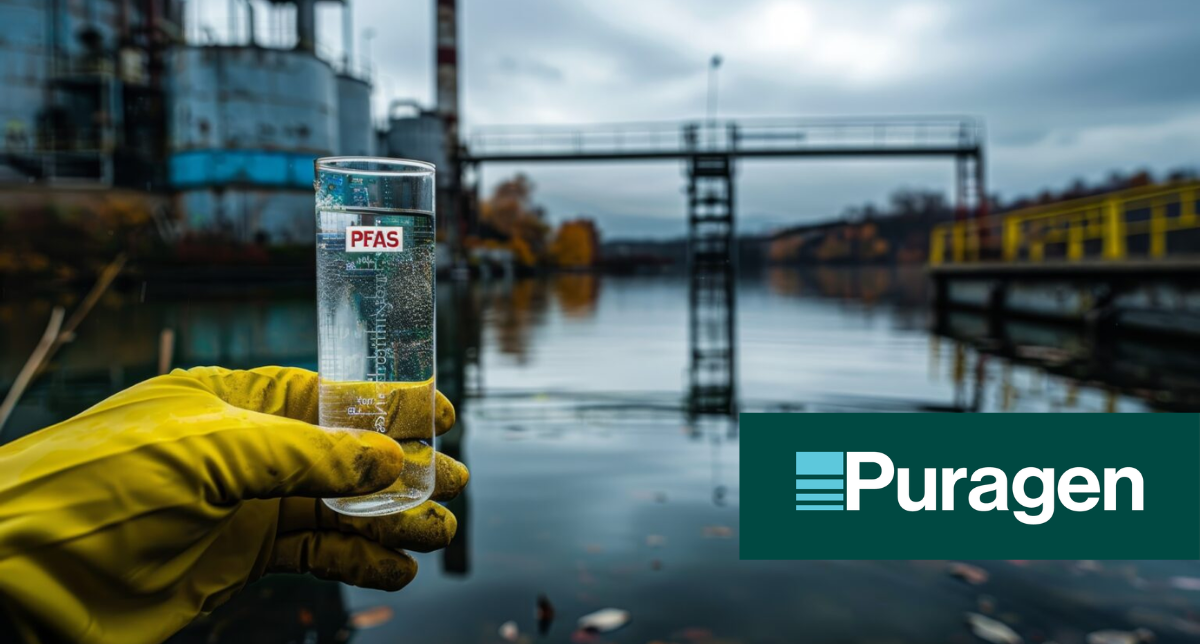
The PFAS Challenge: Why Operators Need Clarity
PFAS has become one of the most pressing environmental issues of recent times— but for operators, the biggest challenge isn’t simply the presence of PFAS in water, waste or industrial systems. It’s the growing complexity around understanding the problem, navigating regulations, and evaluating multiple treatment option solutions.
PFAS is no longer a niche technical topic. It’s a regulatory, operational and reputational issue that touches multiple parts of an organisation. Despite this, many operators still find themselves asking the same fundamental questions: where do we even start? and where do we go next?
Understanding the Problem
PFAS is not one substance, but a vast family of more than 14,000 synthetic chemicals. As such, PFAS have different behaviours, toxicity, persistence and treatment response. Operators need to understand which PFAS are present and what risks they pose. To add to the complexity, analytical methods are still evolving, and commercial laboratory capacity remains limited, making it difficult for operators to build a clear picture of their PFAS footprint.
Navigating Regulations: A Moving Target?
The regulatory landscape for PFAS is becoming increasingly complex. The EU’s proposed PFAS restriction, under REACH, is broad and still under consultation, while several member states, including France, have moved ahead with their own legislation. In the UK, regulators are continuing to scope their future PFAS response, with only limited sector‑specific measures in place so far. When combined with rules emerging across water, waste, food‑contact materials, firefighting foams and industrial processes, operators face a patchwork of obligations that evolve year-by-year.
For many organisations, the challenge isn’t just meeting today’s requirements, it’s anticipating tomorrow’s. Operators must plan for future restrictions, future monitoring obligations and future liability, often without clear timelines or certainty.
Evaluating Solutions:
The market for PFAS solutions is expanding rapidly. This growth brings a new challenge: distinguishing between technologies that capture PFAS and technologies that truly destroy PFAS.
Some solutions remove PFAS, but simply capturing PFAS doesn’t eliminate the problem; it only relocates it. PFAS waste still carries long‑term environmental and regulatory risk, and traditional disposal routes such as hazardous incineration are increasingly viewed as unsustainable, with concerns over emissions and high energy use.
Without a pathway to remove and destroy PFAS entirely, operators risk turning today’s solution into tomorrow’s liability. The real priority is choosing approaches that permanently remove PFAS.
A Practical Framework: Search – Capture – Destroy
This is where a structured approach becomes essential. Puragen’s Search–Capture–Destroy framework offers operators a sustainable solution to capture and destroy PFAS:
- Search: Identify which PFAS are present, at what concentrations, and how they behave in your operation
- Capture: Tailored activated carbon, optimised to effectively and reliably remove a wide range of PFAS
- Destroy: Permanently eliminate PFAS through advanced reactivation and mineralisation technologies, enabling the re-use of activated carbon.
This structured pathway helps operators cut through complexity and build a robust compliance‑led treatment strategy. Puragen’s innovative, award‑winning solution is proven across multiple industries to remove PFAS in both air and liquid‑phase applications. Following implementation, PFAS concentrations have been consistently reduced below regulatory limits, giving operators confidence that the problem is not just managed, but effectively resolved.
The biggest challenge operators face with PFAS isn’t the chemistry alone — it’s the intersection of scientific uncertainty, regulatory fragmentation and a rapidly expanding solutions market. The organisations that succeed will be those that adopt a clear, evidence‑based framework, invest in robust monitoring, and choose technologies that deliver long‑term certainty rather than short‑term fixes.
PFAS is a complex problem. But with the right approach, operators can navigate it with confidence and stay ahead of the regulatory, operational and reputational pressures.
Find out more about Puragen’s solutions at the Energy, Fuels & Decarbonisation Expo on the 16-17 September, where you can meet their team on stand EN-G124 and disucss your PFAS challenges.







